Introducing the Semantic AI Harness
EnterpriseWeb’s deterministic control plane for multi-model, multi-agent management
By Dave Duggal
October 5, 2026
Originally posted on Medium
What is an AI Harness
The hottest topic in AI is not the latest language model; it’s the notion of an “AI Harness” that provides centralized governance over language models and agents.
The rise of the AI Harness is an implicit acknowledgement that Generative AI and Agentic AI, on their own, are not accurate, auditable, efficient or secure enough for mission critical operations — they need a harness. It represents the introduction of a formal control plane to bring order to AI and safely connect it to business systems and workflows.
The Semantic AI Harness
EnterpriseWeb extends the emerging product category by including a Knowledge Plane with graph connected domain concepts, rules and workflows along with typed objects, active state/telemetry, and temporal history. Its deterministic Semantic AI Harness with streaming event data offers a better intelligence layer for AI. By adding the Knowledge Plane, EnterpriseWeb is able to support contextual automation at scale with strong governance.
Context-as-a-Service
Contextual automation requires fine-grained knowledge of how business concepts, data, tasks, tools and rules relate to a specific event or request — not just metrics, logs and traces. The Semantic AI Harness dynamically generates the graph of dependencies for every interaction to provide situational awareness and optimize decisions and actions.
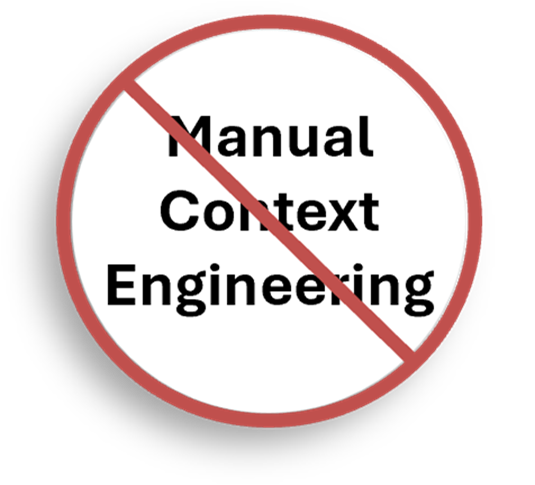
Instead of overloading context windows with manual Context Engineering, EnterpriseWeb uses precise and accurate Context-as-a-Service to:
- Dynamically enrich, refine and validate language model inferences
- Optimize and control agent behavior and support multi-agent coordination
- Enable dynamic workflows, intent-based orchestration and autonomous systems
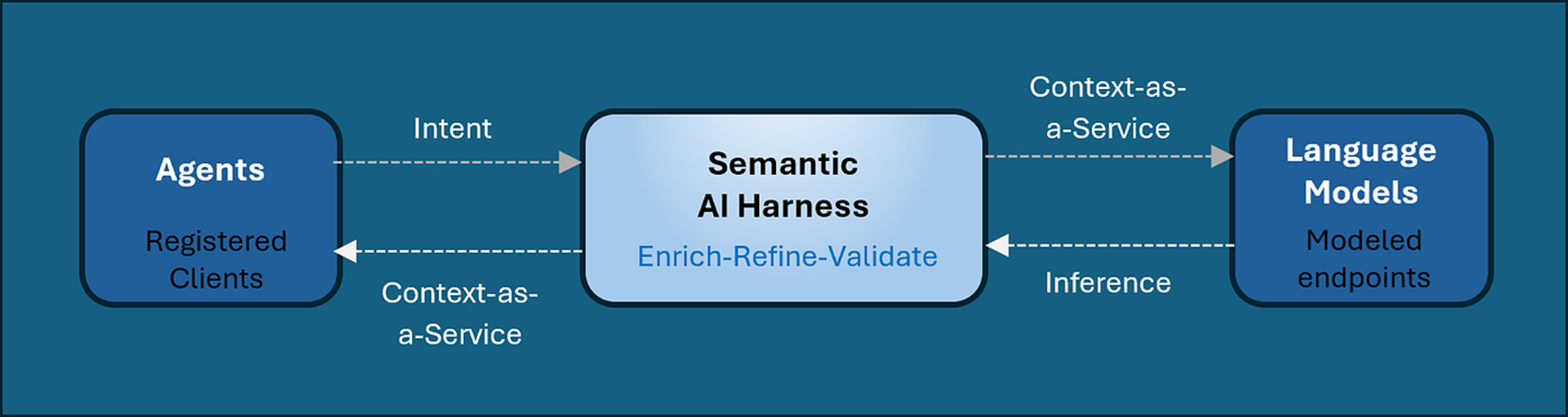
The Semantic AI Harness acts as a deterministic backend for AI; mediating the relationships between language models and agents while enforcing access controls, permissions and contracts. It leverages domain knowledge, typed objects and active state to rewrite agent prompts and provide highly precise Context-as-a-Service to the language model.
Press enter or click to view image in full size
Copyright EnterpriseWeb LLC, 2026
The Semantic AI Harness iteratively enriches and refines language model inferences against the Knowledge Plane until they can be deterministically validated. By shifting processing away from the language model, EnterpriseWeb reduces each “turn” with the LLM to the exchange of only a handful of tokens rather than overloading context windows.
Rewriting Tokenomics
EnterpriseWeb’s Semantic AI Harness is accurate, auditable and governed, as well as ultra-low token, low-latency and resource and energy efficient. It averages only 3 tokens per interaction, 12–15 total (input and output) in a sub-second multi-turn transaction.
EnterpriseWeb’s unprecedented performance was benchmarked in a proof-of-concept “CPU-first Generative AI at the Edge” in collaboration with Intel, Dell, Red Hat and Keysight, which won industry recognition.
Domain-driven AI orchestration for intelligent routing and precise context ensures maximum price–performance as opposed to budget burning tokenmaxxing. EnterpriseWeb puts the ROI in GenAI to reduce OpEx, improve customer retention, and deliver new value-added services.
Hybrid-Reasoning and Parallel Processing
The best way to optimize and control AI is to orchestrate it.
EnterpriseWeb treats language models as composable inference services (local or cloud-based endpoints) registered in a catalog and invoked by workflows. The loose coupling naturally supports intelligent model routing and allows coordination with internal services and external data sources, AI/ML runtimes, and analytics engines.
Rather than depending on language models as the blackbox “intelligence layer” for everything, the Semantic AI Harness supports a “The Best Tools for the Job” approach (e.g., quality, latency, cost).
The Semantic AI Harness can flexibly execute searches, queries, inferences and constraint satisfaction problems across its Knowledge Plane, as well as orchestrate virtualized data sources (e.g., SQL, GQL, SPARQL) and other connected systems. The runtime fans out operations for parallel processing and correlates results for hyper-efficient situational awareness.
Solution Architecture
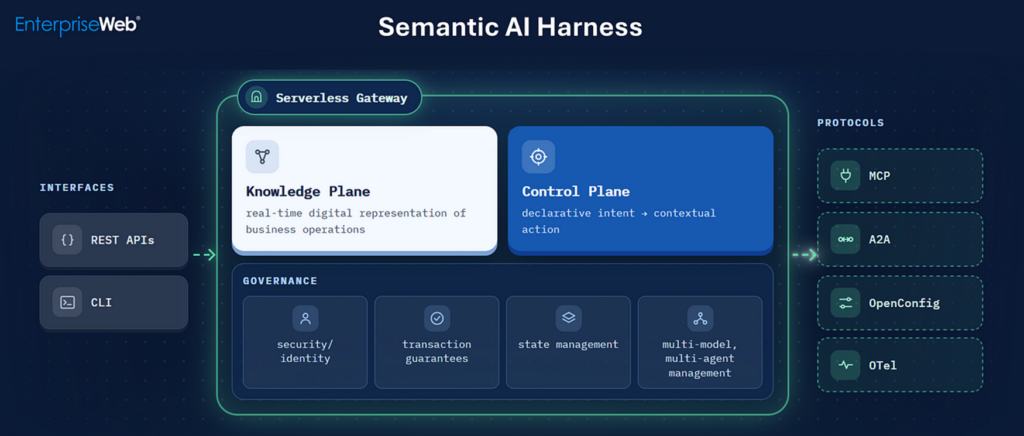
Architecturally, EnterpriseWeb’s Semantic AI Harness is comprised of four parts: Knowledge Plane + Control Plane + Gateway + Governance
Press enter or click to view image in full size
Copyright EnterpriseWeb LLC, 2026
Knowledge Plane
EnterpriseWeb’s Knowledge Plane enables a real-time digital representation of business operations. It brings together an ontology, knowledge graph and topology, along with a system catalog and inventory, in a unified enterprise intelligence layer.
The Knowledge Plane provides persisted, structured domain knowledge, objects, rules, workflows for human, system and agent clients to ensure coherence and consistency across a complex distributed system.
Control Plane
EnterpriseWeb’s Control Plane leverages the Knowledge Plane to translate declarative intent into contextual action.
At the heart of the Control Plane is the Context Engine, a goal-oriented workflow orchestrator for complex, multi-step and long-running processes. It dynamically composes and configures tasks into context-aware pipelines (i.e., graph-based workflows).
The Control Plane’s serverless runtime is event-driven, asynchronous, concurrent with massively parallel processing. It is exposed by a gateway with an intent-based behavioral interface.
Serverless Gateway
No more one-off, manual, static integration. Rather than deploying a stack of specialized components, EnterpriseWeb provides a horizontal elastically scalable architecture with a set of communication, integration and transformation services.
EnterpriseWeb features a serverless gateway that late-binds all connections. The serverless gateway dynamically generates pipelines to deliver targeted contextual payloads through specified interfaces (e.g., REST APIs, CLI) and protocols (e.g., MCP, A2A, OpenConfig, OTel).
The Serverless Gateway leverages the system catalog of typed objects (e.g., distributed endpoints, federated components, virtualized data sources and physical devices) including declaratively modeled interfaces and protocols for any-to-any interoperability, enabling the composable business.
Governance
EnterpriseWeb enforces system-wide governance. It wraps all typed, immutable objects with security/identity and change management. All deployed services in inventory have lifecycle management.
All event-driven, asynchronous transactions are covered by security/identity, reliable messaging, transaction guarantees and state management with rich graph-connected logs and distributed traces. As part of dynamically contextualizing all system responses, the Semantic AI Harness enforces contracts and filters payloads based on permissions to ensure strong, systematic governance.
Governance includes multi-model, multi-agent management.
Use Cases
- Business Process Transformation — Declaratively model workflows as a set of loosely-coupled tasks connected by events and policies, which can be triggered by agents and dynamically composed based on context and permissions
- Intent-based Orchestration — Declaratively model behavioral interfaces that translate human, system or agent intent into action based on interaction context, decoupling client requests, events and prompts from implementations
- Root Cause Analysis and AIOps — Declaratively model tasks as complex events that leverage hybrid transaction and analytics processing (HTAP) to deterministically interpret events, evaluate conditions, translate policies and optimize actions
- Autonomous Systems — Declaratively model complex event-driven processes that combine change data capture, observability and AI for autonomic policy-controlled closed-loops with human oversight and control
- Distributed Transactions — Declaratively model complex integration pipelines that support immutability and idempotency to synchronize distributed systems, federated components and virtualized data sources via APIs, CLI or agents across hybrid and multi-cloud networks
- Infrastructure Management – Declaratively compose application and database stacks, model deployment workflows and management plans, dynamically instantiate observability and AIOps to automate the entire lifecycle (i.e., Design, provision, deploy, orchestrate and manage)
- Network Automation – Declaratively compose Telco or Enterprise-grade network services, model deployment workflows and management plans, dynamically instantiate observability and AIOps to automate the entire lifecycle (i.e., Design, provision, deploy, orchestrate and manage)
It’s time for something new!
Organizations need balanced solutions that mitigate AI’s issues, while leveraging its strengths. EnterpriseWeb enables trusted AI so the business can reason and act with confidence.
If you enjoyed this blog follow me here on Medium and on LinkedIn to keep up with my posts.
Copyright EnterpriseWeb LLC, 2026